
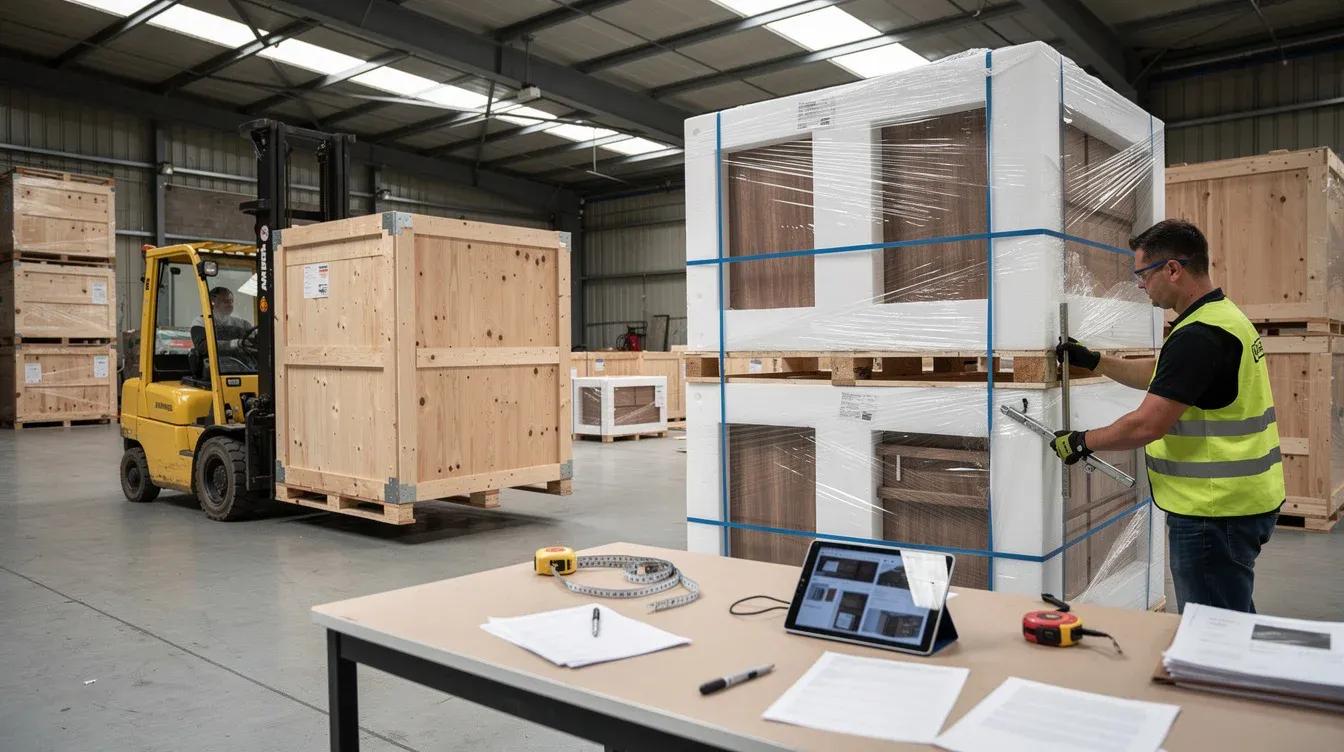
Dubai’s joinery sector has established itself as a powerhouse in global luxury interiors, delivering bespoke kitchens, wardrobes, and wall panels to discerning clients worldwide. Commercial joinery Dubai export represents a significant opportunity for businesses seeking to expand their reach beyond regional markets.
The combination of precision craftsmanship, competitive pricing, and strategic logistics positions Dubai manufacturers as preferred partners for international projects. This guide explores how to scale your luxury interior solutions and capture emerging opportunities in global markets.
Why Dubai’s Commercial Joinery Dominates Global Markets
Precision Manufacturing Meets International Standards
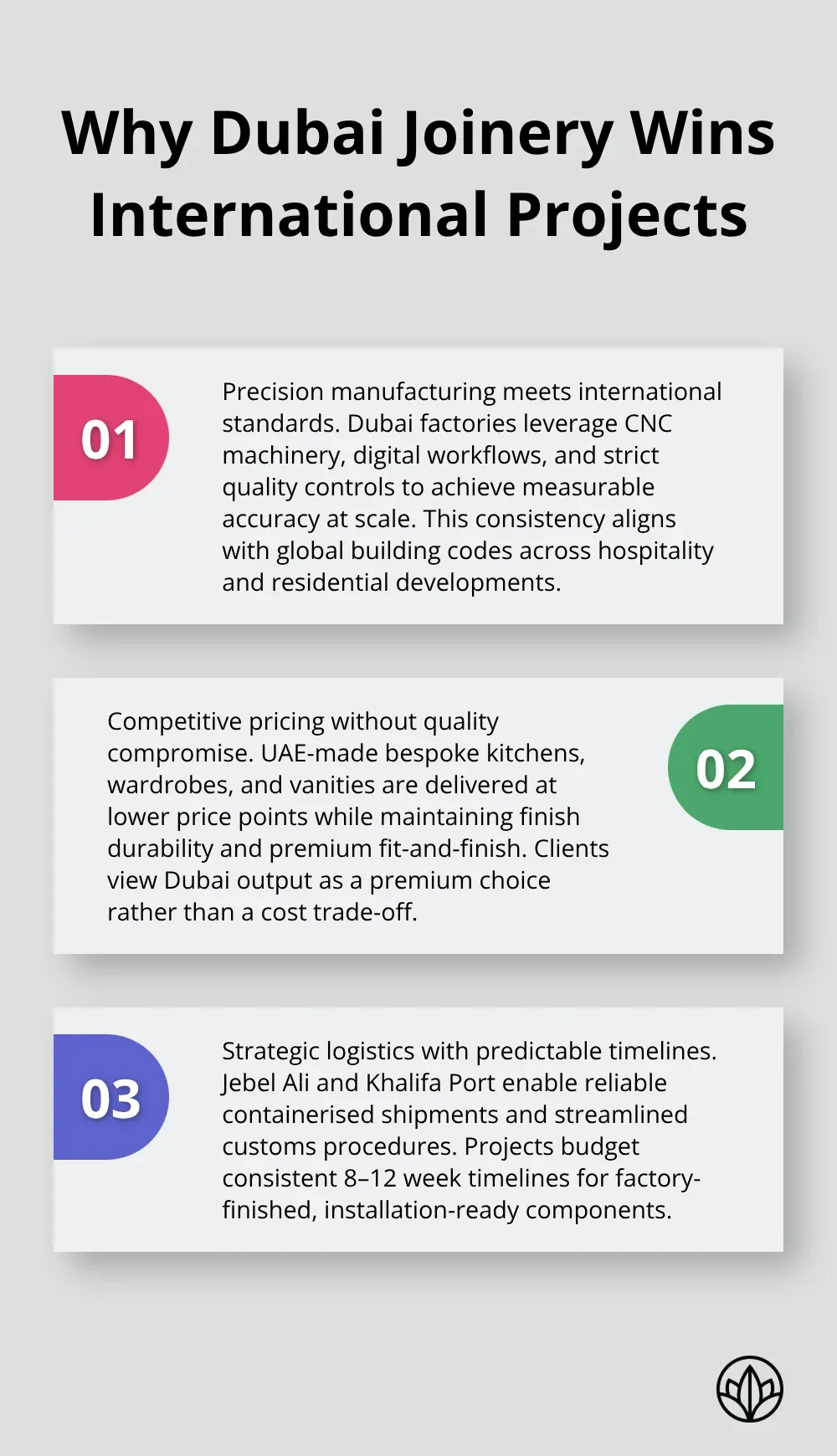
Dubai’s commercial joinery sector commands international respect because it delivers measurable precision at scale. The UAE construction market reached USD 44.54 billion in 2026, creating an ecosystem where manufacturers refine their craft on large, demanding projects before exporting. This domestic pressure-combined with exposure to international building codes through major hospitality and residential developments-ensures that joinery producers meet or exceed global standards without compromise. Factories operating in Al Quoz and Sharjah have invested heavily in CNC machinery, digital design workflows, and quality-control protocols that rival European manufacturers.
Competitive Pricing Without Quality Compromise
The pricing advantage sets Dubai apart. UAE-made bespoke kitchens, wardrobes, and vanities emerge at 20–35% lower price points than equivalent European output, without sacrificing finish quality or durability. This cost efficiency reflects streamlined labor deployment, supply chains rooted in the region’s timber re-export infrastructure, and zero tariffs on imported materials through free zones like Meydan. Clients across North America, Europe, and the GCC region now specify Dubai joinery not as a cost compromise but as a premium choice-precision manufacturing paired with commercial intelligence.
Strategic Port Infrastructure and Logistics Excellence
Logistics cement Dubai’s export leadership. Jebel Ali and Khalifa Port handle containerized joinery shipments with predictable lead times, while the emirate’s established customs procedures for manufactured goods eliminate delays common in less-familiar markets. Luxury residential and commercial projects across Europe and the Middle East now budget 8–12 weeks for commercial joinery timelines because Dubai suppliers consistently deliver modular, factory-finished components that arrive ready for installation.
Integrated Supply Chain Advantage
The timber construction market is projected to grow from USD 17.7 billion in 2025 to USD 44.2 billion by 2035, and Dubai manufacturers capture share through integrated design, production, and export coordination under one roof. This eliminates vendor fragmentation-a persistent friction point for international clients managing multiple suppliers across continents. When a London hotel operator or a Toronto residential developer selects a Dubai joinery partner, they gain access to a single point of accountability for bespoke wall panels, custom doors, and architectural millwork, backed by transparent timelines and compliance documentation that satisfies local building authorities in destination markets. Understanding how to leverage these advantages positions your business to compete effectively in the next phase of international expansion.
How to Build Export-Ready Joinery Operations for International Luxury Markets
Scaling joinery production for international export demands a structural shift from domestic-focused manufacturing to globally compliant operations. The critical difference lies not in design talent but in production discipline, documentation rigor, and logistics orchestration. International clients-particularly hotel operators, residential developers, and commercial fit-out firms across Europe and North America-expect factory-finished components that arrive dimensionally perfect, with finish consistency guaranteed across multiple shipments spanning months or years. This requires implementing modular production workflows where each component fabricates to tolerance specifications tight enough to eliminate on-site fitting delays, then documented with factory inspection certificates, material compliance sheets, and dimensional drawings that satisfy building inspectors in destination markets.
Invest in Precision Infrastructure and Quality Systems
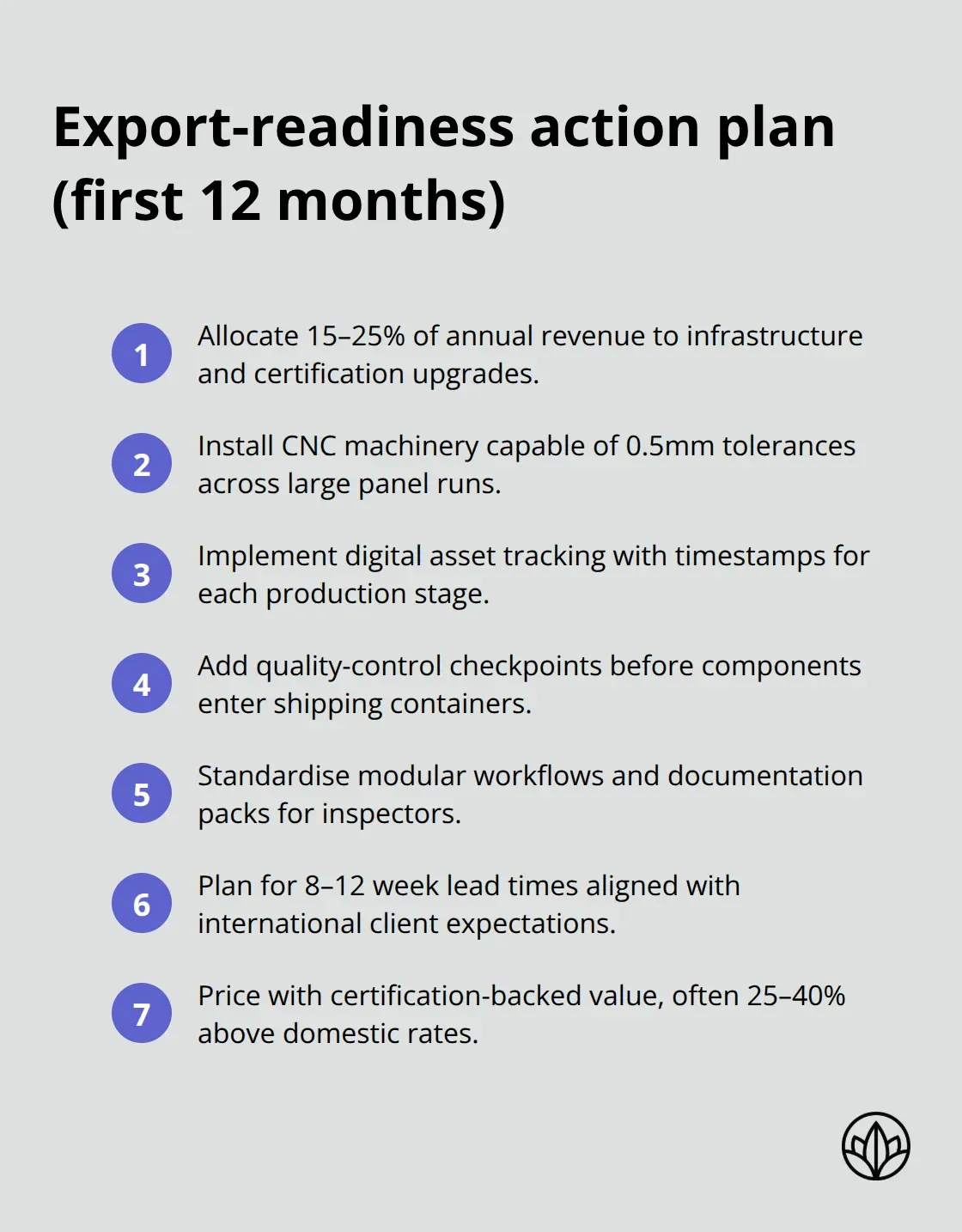
Factories that scale for export typically invest in advanced CNC machinery capable of holding tolerances within 0.5mm across large panel runs, implement digital asset tracking systems that timestamp each production stage, and establish quality-control checkpoints before components enter shipping containers. The investment threshold is real: allocate 15–25% of annual revenue toward infrastructure upgrades, staff training, and certification processes during the first three years of export expansion. However, this investment directly translates to premium pricing power; international clients routinely accept 8–12 week lead times and pay 25–40% above domestic rates when they receive factory-certified components with zero defect tolerance and transparent production documentation.
Meet International Building Standards and Certifications
Compliance with international building standards separates viable exporters from those who face costly shipment rejections and project delays. European Union projects require CE marking documentation for certain joinery categories, fire-rating certifications aligned with EN standards, and material safety data sheets confirming low-VOC finishes for commercial interiors targeting LEED or BREEAM certification. North American projects demand compliance with IBC codes, impact-resistance testing for high-traffic hospitality environments, and often require third-party inspection reports issued by locally recognized testing labs.
Establish Documentation Systems and Testing Protocols
The practical path forward involves partnering with an international standards consultant during the first 6–12 months to audit your production processes, identify certification gaps, and establish the documentation systems that transform your factory into a trusted supplier within global building ecosystems. Many successful Dubai manufacturers maintain standing relationships with testing facilities in Abu Dhabi and Sharjah, conducting batch testing on new finishes and material combinations before full production runs, then archiving test results indexed by project and shipment date. This approach costs 2–4% of project value but eliminates the far costlier scenario where components arrive at a London luxury residence only to be rejected because finish specifications don’t align with local environmental regulations.
Optimize Logistics and Compliance Coordination
Logistics efficiency amplifies this advantage: containerized shipments departing Jebel Ali or Khalifa Port reach European ports within 3–4 weeks, and advance notification of compliance documentation to destination customs authorities accelerates clearance. The most aggressive exporters embed a compliance officer within their sales team, ensuring that each client inquiry triggers a checklist review of destination-market requirements before quoting begins. This transformation converts regulatory complexity from a barrier into a competitive differentiator that positions your operation to capture premium international projects. The next phase of growth depends on how effectively you translate these operational foundations into client relationships that span continents and multiple project cycles.
Where Global Demand for Luxury Joinery Concentrates Today
European Markets Drive Certification-Led Specifications
The global luxury furniture market was valued at USD 26.5 Billion in 2025, with hospitality and high-end residential projects accelerating growth across Europe, North America, and the GCC region. European developers targeting LEED and BREEAM certifications now specify bespoke kitchens and wall panels manufactured in Dubai because certified sustainable materials, precise factory finishing, and transparent compliance documentation satisfy local building authorities faster than sourcing from fragmented European suppliers. The efficiency advantage proves decisive: a London luxury residence or Frankfurt hotel operator selects a single Dubai manufacturer to manage design, production, and installation across multiple properties simultaneously, eliminating coordination delays that plague multi-vendor approaches.
North American Residential and Branded Development Expansion
North American residential markets-particularly Toronto, Vancouver, and major US metropolitan areas-have shifted toward Dubai joinery manufacturers for branded residences and ultra-luxury condominiums. Design continuity across multiple units demands factory-finished components that arrive with zero tolerance for dimensional variation. Dubai producers deliver this precision consistently, which North American developers recognize as a competitive advantage over domestic suppliers managing fragmented production networks. The premium pricing that international clients accept reflects this reliability: they pay 25–40% above domestic rates for components that eliminate on-site fitting delays and guarantee finish consistency across project phases spanning months or years.
GCC Regional Opportunities and Repeat Order Pipelines
The GCC region itself represents the most immediate expansion opportunity. Projects across Abu Dhabi, Saudi Arabia, and Qatar increasingly specify Dubai-made joinery not for cost arbitrage but because local architects and developers recognize the efficiency advantage of working with a single manufacturer. Hospitality operators in particular drive consistent repeat orders, with Dubai hotel fit-outs creating 12–24 month project pipelines where the same bespoke kitchen finishes, vanity specifications, and door hardware replicate across dozens of guest suites, staff areas, and public spaces. This creates predictable revenue visibility that surpasses one-off residential projects and establishes long-term client relationships that sustain growth.
Client Relationship Management and Digital Integration
Long-term client relationships in these markets depend on operational discipline that international developers expect as standard. Establish a dedicated export account manager assigned to each major client, conduct quarterly business reviews reviewing upcoming projects and lead timelines, and maintain a rolling 18-month project pipeline dashboard shared with key accounts so they integrate your manufacturing schedule into their master planning. The most successful exporters implement a client portal where project managers access real-time production status, compliance documentation, and dimensional drawings indexed by shipment date, eliminating communication friction that derails international relationships.
Technology Tools That Command Premium Pricing
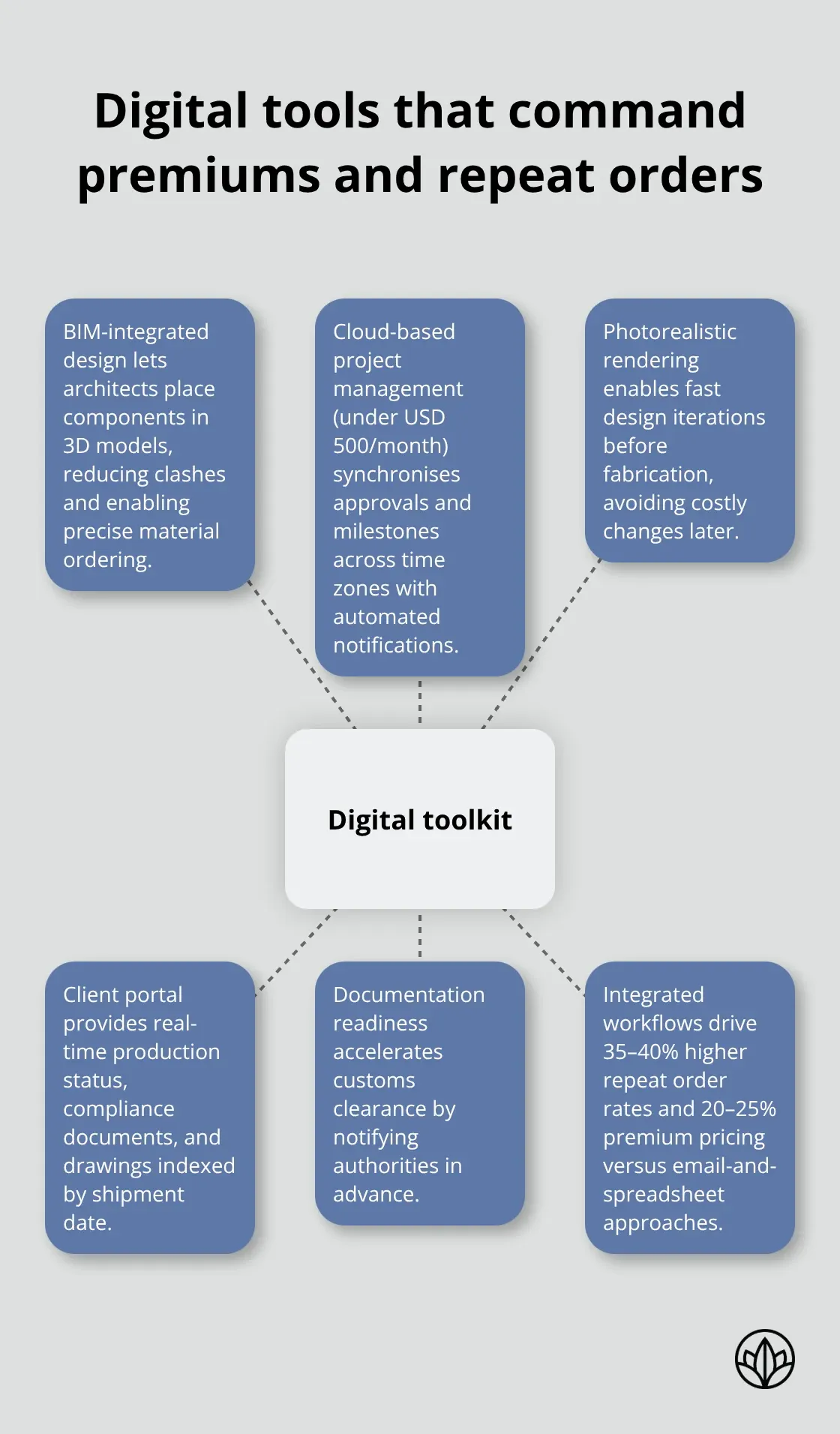
Digital tools amplify competitive advantage: deploy BIM-integrated design workflows so architects embed your components into 3D models before fabrication starts, reducing design conflicts and enabling precise material ordering that minimizes waste. Cloud-based project management platforms (such as Asana or Monday.com) cost under USD 500 monthly per account but transform how you coordinate with international teams across time zones, ensuring that design approvals, material selections, and production milestones trigger notifications that keep projects aligned. Invest specifically in photorealistic rendering software that visualizes bespoke kitchens, wardrobes, and wall panels in client spaces before production starts, because international developers routinely request design iterations that cost nothing in digital format but become expensive once fabrication begins. Manufacturers who embed these tools into their client workflows capture 35–40% higher repeat order rates and command 20–25% premium pricing compared to competitors relying on email and spreadsheets.
Final Thoughts
Dubai’s commercial joinery export sector delivers precision manufacturing, competitive pricing, and integrated logistics that position your business to compete effectively in global luxury interior markets. International clients-from London hotel operators to Toronto residential developers-now recognize Dubai-made bespoke kitchens, wardrobes, vanities, and wall panels as a premium choice, not a cost compromise. This shift reflects operational discipline: factory-finished components arrive dimensionally perfect, compliance documentation satisfies building inspectors across jurisdictions, and transparent timelines integrate seamlessly into international project schedules.
Your international growth requires three immediate actions. First, audit your production infrastructure against the precision standards that international clients expect and invest in CNC machinery capable of holding 0.5mm tolerances, digital asset tracking, and quality-control checkpoints before shipment. Second, secure the certifications and compliance documentation that destination markets demand-CE marking for European projects, fire-rating certifications, LEED-aligned material specifications-through partnerships with standards consultants during your first 12 months of export expansion.
Third, embed digital tools into your client workflows: BIM integration, cloud-based project management, and photorealistic rendering eliminate design friction and command premium pricing compared to competitors relying on traditional communication methods. The global luxury furniture market continues expanding, and commercial joinery Dubai export represents a direct pathway to capturing share in high-margin residential and hospitality segments. Contact us today to discuss how your business can enter or expand within global markets and get a quote for your next project.
Cordoba Interior Factory | Premium Bespoke Joinery. Serving Dubai & Sharjah. Custom kitchens, wardrobes, and luxury wall paneling crafted to perfection with no minimum order limit. Request a Free Quote Today!